
Love it or hate it, dairy data continue to grow and evolve as information points to help producers and consultants make dairy cattle management decisions. During the National Mastitis Council Annual Meeting, Torben Werner Bennedsgaard of Bovicura A/S, Aars, Denmark, addressed the use of sensor-supported udder health management from a consultant’s perspective. He noted that in Denmark, automated milking systems (AMS) are used in 23.5 percent of the country’s dairy herds, with 215 herds using DeLaval VMS, 355 using Lely AMS and 17 herds using other AMS types.
In a typical Danish dairy herd with AMS, the producer/consultant/veterinarian records treatments and the system monitors cow activity, rumination, cow and quarter level production, milk conductivity and either test-day or online somatic cell counts. A few AMS models measure body weight, body condition, lactate dehydrogenase and/or beta-hydroxybutyrate.
Bennedsgaard noted that since the start of AMS in Denmark, the bulk tank somatic cell count (BTSCC) has been higher in AMS herds than conventionally milked herds. However, the difference is decreasing. In 2020, the geometric average BTSCC in herds with Lely AMS were nearly identical to the conventionally milked herds, whereas herds with DeLaval VMS had a geometric average 30,000-40.000 cells/ml higher.
AMS quality improves
“The quality of milking robots has improved dramatically over the past couple years,” Bennedsgaard stated. For example, Lely introduced the model A5 and made software upgrades to older models and DeLaval introduced the VMS300 and VMS310. “In both cases, we have seen both increased production and reduced BTSCC after introducing the new models. So, the differences between SCC in conventional milking and AMS might be reduced even further.”
Bennedsgaard believes the milk quality improvements are related to improved cleaning, milking unit attachment and teat spraying in the new models. However, differentiated vacuum – depending on milk flow – can have a positive effect on individual cows’ SCC. “Improved sensors and data evaluation have also encouraged more farmers to use the automatic separation of abnormal milk.”
Bennedsgaard said that comparing test-day records from AMS and conventionally milked herds can be difficult. “Until now, AMS test-day records have been less reliable due to milk carryover and milk components from previously milked cows in the sampling process. As a result, a higher percentage of cows with new acute high cell counts are seen, though the percentage of cows with chronic high SCC remains largely unchanged. If the sampling process is not optimized, the carryover can be as high as 10 percent, which has a large effect on SCC. It is important to evaluate whether other measurements in the milking system are affected by carryover, including integrated cell counting, LDH (L-lactate dehydrogenase), color or conductivity measurements.”
Measurements can be overwhelming
When using new sensors in a milking system, Bennedsgaard recommends farmers take time to adapt to this abundance of information. For example, SCC numbers fluctuate on a daily basis. “The first reaction might be that either the test-day records or sensor data must be wrong,” he commented. “Most farmers will primarily use the aggregated parameters made available by the milking system as a score or risk of infection. However, learning to understand the different graphs showing the variation between milkings can help farmers make better treatment and/or culling decisions.”
Figure 1 shows different graphs for a cow infected with non-aureus staphylococci in a single quarter. After the first couple of weeks of lactation, the online cell counter (OCC) cell count shows periodic bursts but mostly stays low. The HerdNavigator mastitis risk shows small rises at the same time but doesn’t give an alarm due to the short duration of spikes in infection level. The red and blue markings in the middle graphs are Bennedsgaard’s additions to show the difference in information available with two different sets of two test-day recordings one week apart. “If the test days were at the red markings, the conclusion would be a falling SCC or even ‘cure’,” Bennedsgaard explained. “For the blue markings, the conclusion would be a new infection.”
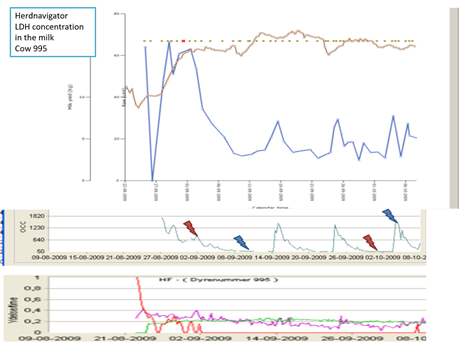
Figure 1. Three graphs for the same cow in a herd with DeLaval VMS with HerdNavigator or OCC. The graphs show milk production and HerdNavigator mastitis risk (upper graphs), OCC cell count (middle), measurements of blood (red) and conductivity (purple), and yield per hour (green) for one of the quarters (green).
What can we learn from sensor data? Bennedsgaard replied, “When going through cow data in herds with sensor data and information on repeated culture of teats, we often find a group of cows with nearly constantly low SCC or other mastitis indicators, but a constant infection of Staphylococcus aureus, for example. Normally, we don’t have any information whether these cows are infected with the same strain of Staph. aureus as the cows with high SCC. These cows could be characterized as having ‘silent mastitis,’ with an SCC <200,000, for example, 75 percent of the time.” Looking to the future, Bennedsgaard said that the better sensor data we get the easier these cows can be identified. “Currently, carryover and senor instability can make identifying these cows difficult.”
Moving forward, Bennedsgaard wonders if indirect measurements will be precise enough to identify “silent mastitis” cows. “Maybe we need cheap and reliable direct measurements of pathogens to identify these cows. However, today’s ‘carryover problem’ is probably the biggest challenge to effectively use sensor data for making udder health management decisions.”
The National Mastitis Council does not support one product or business over another. Any mention herein is meant as an example – not an endorsement.