

January 2022, Volume 45, No. 1

Attend the NMC Annual Meeting –
In Person or Virtually
If you haven’t registered for this year’s National Mastitis Council (NMC) Annual Meeting, do it today! It’s just a few short weeks away – Feb. 1-3, at the Town and Country Resort, San Diego, Calif., USA, and on the internet.
Given the persistence of the COVID-19 pandemic and related travel restrictions, NMC is providing a “hybrid meeting” – with in-person and virtual attendance options. The 2022 NMC Annual Meeting theme revolves around “Future Frontiers.”
The pre-registration deadline for in-person attendance is Jan. 17. On-site registrations will be accepted in San Diego and virtual attendance registrations will be accepted until Feb. 1.
Virtual attendance
For virtual attendees, NMC will provide web links so you can attend via livestream. All sessions will be recorded. If the “live session” isn’t conducive to your schedule or time zone, just view the recordings at a later time. Recordings will be available for viewing by late February.
This year’s NMC Annual Meeting promises to provide practical and deliverable information for milk quality enthusiasts involved in the dairy industry as veterinarians, dairy producers, researchers, extension specialists, industry suppliers, dairy processor field representatives, regulatory officials, teachers and students. NMC Annual Meeting details may be found at: http://meeting.nmconline.org. Click here to register for the meeting.
Research poster list online
Take a sneak peek at the posters that will be presented during the Technology Transfer Session. Click here to view the titles and authors. By Feb. 1, NMC will post oral presentation recordings of the 2022 Technology Transfer Session research posters. Keep an eye on your e-mail inbox for more details. Posters 1 through 10 will be presented orally, with time for questions and answers, during the Research and Development Summaries session, starting at 2 p.m. Pacific time (California time) on Feb. 2.
With a central location in Mission Valley, the Town & Country Resort is within minutes of the San Diego International Airport (SAN), golf, beautiful beaches, hiking, biking and world-class attractions. To make your hotel reservation(s), click here or call 619-291-7131. The NMC group rate is available until Feb. 1.
Questions? Feel free to contact Kristy Mach (kristy@nmconline.org), JoDee Sattler (jdsattler@nmconline.org), Kyle Wieskus (kyle@nmconline.org) or Sue Schatz (sue@nmconline.org).
Congratulations to Research Poster Presenters
The National Mastitis Council (NMC) Research Committee accepted 37 research posters for the 2022 Technology Transfer Session (TTS), being held in conjunction with the 2022 NMC Annual Meeting. Researchers recorded summaries of their research, which will be available to in-person and virtual NMC Annual Meeting registrants on a micro website. Meeting registrants will receive an e-mail about how to access these recordings.
In addition, the first 10 posters (listed below) will be presented during the Research and Development Summaries Session, set to start at 2 p.m. Pacific time on Feb. 2. The complete list of TTS papers, authors and their affiliations is shown below.
View the entire list of titles and presenters here.

NMC Welcomes Dairymaster as a
New Premier Member
In this issue of Udder Topics, we feature a new National Mastitis Council Premier Member – Dairymaster.
Dairymaster integrates technology to dairy milking, feeding, cooling and health/fertility monitoring systems that contribute to a dairy farm’s return on investment while supporting the need for healthy cows. Dairy farms using Dairymaster technology witness increased milk yield, reduced milking time, reductions in energy costs, decreased labor and improved herd health and conception rates.
A unique milking approach reduces milking machine induced mastitis by minimizing cross-contamination in the claw and by taking advantage of the cow’s natural oxytocin release, resulting in faster milking and lower somatic cell counts.
Growing global milk consumption and environmental awareness is affecting worldwide milk supply, placing the United States in a unique position for growth and why Dairymaster is investing in this market. Emphasis on research and development ensures that Dairymaster provides the most durable, easy-to-install and serviceable technology. Dairymaster offers the knowhow that optimizes efficiency and comfort for operator and cow.
The Dairymaster team looks forward to meeting NMC members at the National Mastitis Council Annual Meeting.
U.S. Animal Drug Residues Take
Another Drop
The U.S. Food and Drug Administration (FDA) reported an industry low for animal drug residues in milk from Oct. 1, 2020-Sept. 30, 2021. This gives consumers additional assurance that dairy foods are safe to consume.
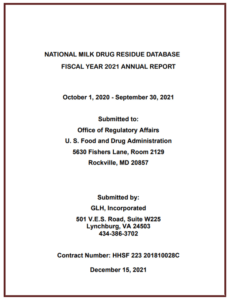 During the one-year period, the industry tested nearly 3.9 million milk samples for animal drug residues. FDA’s National Milk Drug Residue Database Fiscal Year 2021 report revealed that only 451 of those samples tested positive.
All bulk milk tankers must be sampled and tested for animal drug residues before entering a milk processing system. If a load tests positive, it is rejected. Approximately 13.24 million pounds of milk yielded a positive drug residue and was consequently disposed of during fiscal year 2021 – down from 15.87 million pounds during the previous fiscal year.
Testing is done at four points throughout the production system – bulk milk pickup tankers, dairy farms, other (e.g., milk from milk plant tanks/silos) and pasteurized fluid milk and dairy products. All but one violation during the 2021 fiscal was caught at the bulk milk tanker or dairy farm testing level. The percent of positive samples cannot be provided because there is no uniformity in terms of sampling in the four categories.
Fine-tuning Udder Health Monitoring with
Sensor Systems
Stripping and checking foremilk for abnormalities (e.g., flakes and clots) prior to attaching a milking unit plays a key role in mastitis detection, according to the National Mastitis Council (NMC). With the advent and installation of automatic milking systems (AMS), detecting abnormal milk (clinical mastitis [CM]) with the naked eye is not possible anymore. Thus, detecting mastitis in AMS became an area of research and development interest.

Henk Hogeveen, Wageningen University and Research, Wageningen, the Netherlands
“Automated detection of mastitis is an integral part of automatic milking to ensure milk quality and maintain animal welfare through the prompt attention to cows with clinical (painful) mastitis,” stated Henk Hogeveen, Wageningen University and Research, Wageningen, the Netherlands, during the 2021 NMC Annual Meeting. “In the future, sensor systems to support mastitis management may also become more common in conventional milking parlors.”
Industry experts want CM detection models to achieve 80 percent sensitivity and 99 percent specificity. Unfortunately, no published CM detection models meet this target. ”Although work is still underway to improve algorithms and sensor systems, it will be hard to reach this target in the foreseeable future,” Hogeveen remarked. Due to the sub-optimal performance of current CM detection systems, farmers must check many cows per day (false positives, which are a consequence of a low specificity) or have to accept that a lower proportion of cows with CM will be detected in time (false negatives, which are a consequence of low sensitivity).
While automated mastitis detection systems “visually” detect CM, these systems offer so much more. For example, they make multiple measurements per day and can combine several parameters to detect and monitor mastitis. “To empower farmers that are using sensor systems for managing and monitoring udder health effectively, we need to identify and describe typical mastitis management situations in these systems,” Hogeveen explained.
During his presentation, Hogeveen defined four mastitis situations in which automated mastitis detection systems can aid farmers’ management by identifying mastitis cases that require or could benefit from appropriate intervention. The guidelines help farmers manage mastitis by using the benefits of sensor systems, as much as possible. Here’s a look at how these situations may work with AMS mastitis detection systems.
Cows needing immediate attention
CM severity is typically classified as mild (Grade 1), moderate (Grade 2) or severe (Grade 3). Cows with mild CM have abnormal milk as the only clinical sign. Cows with moderate CM have abnormal milk and quarter and/or udder changes, such as inflammation, redness, pain and/or warmth. Cows with severe CM have compromised health, with one or more systemic signs of illness, such as abnormal rectal temperature, dehydration and/or marked depression. “Even though the incidence of severe CM is usually low, the severe consequences underline the necessity of accurate and early detection from animal welfare and economical perspectives,” Hogeveen stated.
A cow with severe CM needs immediate attention and treatment under veterinary supervision. “Immediate in this context means to detect affected cows within hours of developing clinical signs and initiate appropriate treatment as soon as possible following detection by the system,” Hogeveen explained.
The sudden onset of severe clinical signs poses high demands on an on-farm sensor system. Sensor information based on changes in milk and measurements collected during milking will not be sufficient for all cases. Cows with severe CM may not visit the AMS and sensor data from the previous milking may show little deviation. Combining several sensor-based and automatic milking-based indicators may be needed to reach the necessary demands. For example, if a cow does not visit AMS on her own, she may be checked for disease symptoms when being fetched.
To evaluate a cow that potentially has CM, look at her milk (e.g., signs of flakes, clots), udder (e.g., hard spots, heat) and general condition (e.g., rectal temperature, dehydration, rumen function, attitude, diarrhea). With the herd veterinarian, develop a herd-specific identification and treatment protocol.
Cows not needing immediate attention
With subclinical mastitis (SCM), there’s mammary gland inflammation – but no visible milk abnormalities. Mild CM involves udder inflammation and observable milk abnormalities.
Some dairy producers treat all CM cases with antibiotics, including mild CM cases, immediately upon detection. “From an animal welfare point of view, there is no need to treat cows with mild CM immediately,” explained Hogeveen. Cows often self-cure and some pathogens don’t respond to antibiotics.
Due to cost, dairy producers don’t usually take routine somatic cell count (SCC) measurements of individual cows. Even within DHI SCC programs, the SCC measurements are only available every four to six weeks. As a result, a cow’s mastitis status is not known at all times and many infections go undetected. AMS sensor systems may provide daily monitoring of SCM and mild CM. “This information helps producers make informed and targeted decisions – provided the software delivers information and not just data,” Hogeveen remarked.
Sensor systems that identify cows with mild CM or SCM should have reasonable sensitivity to ensure that an acceptable number of cows with mild or SCM are detected. The consequences of these cases are relatively mild; therefore, it is not important to have a very high sensitivity. Moreover, sensor systems to detect cows with mastitis that do not need immediate intervention should have a very high specificity to prevent false-positive alerts. There is no need for quick intervention; up to about seven days is acceptable.
Protocols should focus on reducing risk factors or reducing transmission of udder pathogens among cows. In AMS, additional (steam) cleaning after milking mild CM or SCM cows may likely reduce transmission during milking.
Cows needing attention at dry-off
Selective dry cow therapy (SDCT) allows dairy operations to reduce antimicrobial use. This helps lower costs and fosters judicious antimicrobial use. Due to the continuous measurements over a lactation, sensor systems may provide excellent data to identify cows that have an intramammary (IMI) at dry-off and thus need “traditional” dry cow therapy. Without an IMI at dry-off, a cow only receives an internal teat sealant (SDCT).
If a cow is selected for dry cow therapy, treat her with an antimicrobial that targets the IMI pathogen, Hogeveen recommended. Microbiological diagnosis can help identify the pathogen, making more specific antimicrobial treatment possible.
Monitoring udder health at the herd level
Besides their use in individual mastitis situations, sensor systems may also be used at the herd level. Sensor systems monitor udder health by giving a day-to-day overview of the herd-level mastitis situation. “Monitoring is an important aspect of dairy herd health management,” stated Hogeveen. “Given the multifactorial nature of mastitis, the contagious nature of some mastitis pathogens and on-farm risk factors, mastitis status quo can easily be disturbed by unexpected reasons, leading to decreased udder health. Because of some mastitis pathogens’ contagious nature, changes in the herd’s mastitis status may develop quickly and lead to mastitis problems associated with severe production losses, excessive use of antimicrobials and reduced animal welfare.”
Improved monitoring may lead to earlier detection of a herd’s altered mastitis situation. “An adequate response related to that detection can lead to a quick adjustment so that negative effects of the mastitis problem are quickly resolved,” Hogeveen added. To support herd-level monitoring, key performance indicators (KPI) can be developed. Such KPIs can be used to detect deviations from the expected or planned level of udder health. Frequently used mastitis-related KPIs include incidence of CM, bulk milk SCC, average cow milk SCC and the number of cows with a new high SCC.
The specificity of a sensor system to monitor mastitis at the herd level should be very high to prevent an unnecessary and time-consuming investigation into a problem that does not exist. Therefore, avoid false-positive mastitis alerts at the herd level because they are costly. The sensitivity should be as high as possible. The time frame for detecting a herd-level issue can be greater than cow-level alerts.
Hogeveen wrapped up by saying that sensor systems have great potential to support mastitis management. “For a full and successful implementation of sensor-based mastitis management, the algorithms of these sensor systems should be specifically targeted to monitor all four mastitis situations, instead of using one alert algorithm.”
To read Hogeveen’s complete proceedings paper, visit the NMC Member Center and type in your username and password.